

Get Patches Made for Your Apparel Logo
2026-06-23
Table of Contents
- Core Patch Categories for Apparel Logos
- Patch Type Specification Comparison
- Standard Size Ranges by Garment Placement
- Backing and Attachment Options
- Production Specifications and Technical Parameters
- Order and Production Workflow
- Quality and Durability Standards
- Design Optimization Guidelines
- Material and Environmental Considerations
Branded patches elevate every garment they touch. From work uniforms and team jerseys to retail apparel and promotional merchandise, a well-crafted logo patch turns ordinary clothing into a walking billboard for your brand.
Getting patches made for your apparel logo involves selecting the right material, specifying accurate dimensions, choosing a reliable attachment method, and working with a manufacturer that delivers consistent quality across every batch.
Core Patch Categories for Apparel Logos
Different patch technologies produce distinct visual and tactile results. Each category serves specific garment types, design complexities, and durability requirements.
Embroidered patches remain the most widely recognized format for apparel branding. Computerized embroidery machines stitch colored thread onto a polyester twill base, creating raised surfaces with noticeable texture and depth. Bold logos and block lettering translate especially well to this format. Standard production supports up to 12 thread colors per design, with minimum text height around 4mm to maintain legibility.
Woven patches use fine interlaced threads instead of raised stitching, resulting in a smooth, flat surface that reproduces intricate details with exceptional clarity. Small text, gradient transitions, and complex linework all render sharply on woven patches. The thinner profile works seamlessly on dress shirts, polos, and lightweight outerwear where bulk would disrupt the garment fit.
PVC patches deliver waterproof, weather-resistant branding built for harsh conditions. Molded from flexible polyvinyl chloride, these patches feature sculpted 3D surfaces and vibrant solid colors. Outdoor gear, workwear, tactical apparel, and sports uniforms all benefit from the mud-resistant, fade-proof performance of PVC construction.
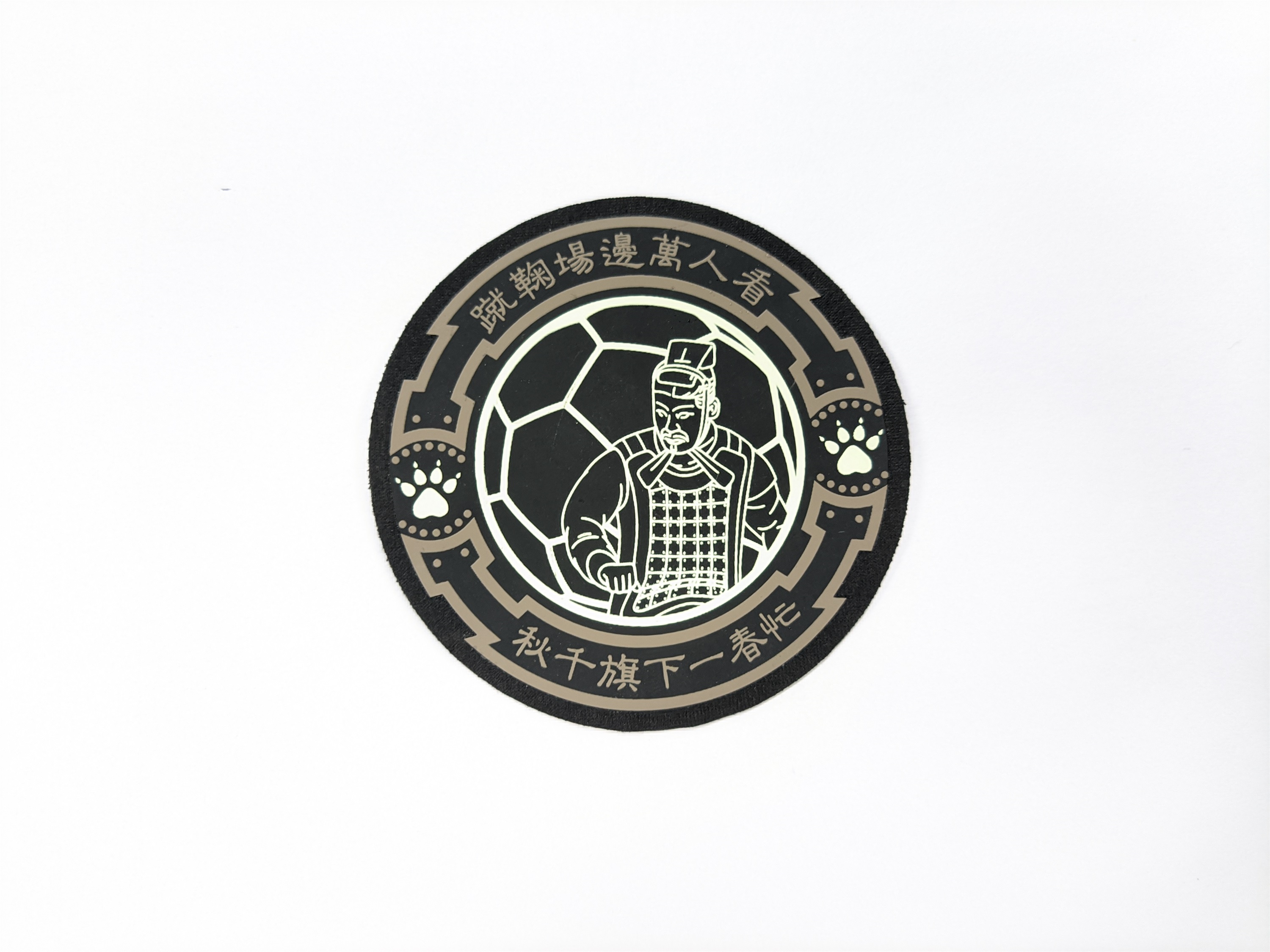
Silicone patches offer a soft-touch alternative with similar durability advantages. The rubber-like material flexes with garment movement and maintains color integrity through repeated washing and UV exposure. Silicone logos appear frequently on athletic apparel, swimwear, and children’s clothing where comfort and safety rank as top priorities.
Leather patches bring premium, rugged aesthetics to denim, canvas, and heavy outerwear. Available in genuine or vegan leather, these patches accept embossed, debossed, or laser-engraved logos that develop natural character over time. Jeans, work jackets, and canvas bags are the most common applications.
Patch Type Specification Comparison
|
Patch Type
|
Surface Texture
|
Color Capacity
|
Minimum Text Height
|
Typical Thickness
|
Best For
|
|
Embroidered
|
Raised, textured stitching
|
Up to 12 thread colors
|
4mm
|
1.2–2.0mm
|
Uniforms, jackets, hats
|
|
Woven
|
Smooth, flat finish
|
Unlimited woven colors
|
2mm
|
0.4–0.7mm
|
Dress shirts, fine details
|
|
PVC
|
Sculpted 3D, smooth
|
Up to 8 solid colors
|
3mm
|
1.5–3.0mm
|
Outdoor gear, workwear
|
|
Silicone
|
Soft rubber matte
|
Up to 6 colors
|
3mm
|
0.8–2.0mm
|
Sportswear, swimwear
|
|
Leather
|
Natural grain texture
|
Deboss / emboss / print
|
5mm
|
1.0–2.5mm
|
Denim, bags, outerwear
|
Standard Size Ranges by Garment Placement
Patch dimensions directly impact visibility, production cost, and wearer comfort. Sizing follows the garment area where the logo will appear.
Chest placement on adult shirts and jackets typically uses patches between 70mm and 100mm at the widest point. Left chest positioning remains the industry standard for corporate apparel and uniform programs. Sleeve patches run smaller, usually between 50mm and 75mm, to fit within the arm seam boundaries.
Hat patches follow different proportions. Front panel designs on structured caps commonly measure 70mm to 90mm wide, while side patches scale down to 30mm–50mm. Trucker hats and beanies each have their own optimal dimensions based on fabric stretch and curve.
Back patches cover the largest surface area. Full-back jacket patches can reach 250mm or more, while smaller back placements on shirts stay in the 100mm–150mm range.
Recommended Patch Sizes by Garment Location
|
Placement
|
Small Size
|
Medium Size
|
Large Size
|
Common Garments
|
|
Left Chest
|
50–60mm
|
70–85mm
|
90–100mm
|
Shirts, jackets, polos
|
|
Sleeve
|
30–40mm
|
45–55mm
|
60–75mm
|
Work shirts, uniforms
|
|
Hat Front
|
50–60mm
|
70–80mm
|
85–95mm
|
Baseball caps, beanies
|
|
Full Back
|
100–120mm
|
150–180mm
|
200–250mm
|
Jackets, hoodies
|
|
Collar / Neck
|
20–25mm
|
30–35mm
|
40–45mm
|
Dress shirts, inner labels
|
Backing and Attachment Options
Every patch requires a backing system that secures it to the garment. Manufacturers offer several attachment methods, each with different installation requirements and permanence levels.
Heat seal backing, also called iron-on backing, uses a heat-activated adhesive film applied to the patch reverse side. Application requires a heat press set between 150°C and 165°C for 10 to 15 seconds at medium pressure. Once properly applied, heat seal patches form a permanent bond that survives regular washing cycles. This backing works with embroidered, woven, and PVC patch styles.
Sew-on backing leaves the patch back exposed so it can be stitched directly to the garment. This method delivers the highest durability and is standard for leather patches, heavy workwear, and items that undergo industrial laundering. Merrowed edges or laser-cut edges both support sew-on application.
Pressure-sensitive backing features a peel-and-stick adhesive intended for temporary or light-use placement. Event badges, promotional giveaways, and limited-run merchandise often use this backing option. The bond is not designed for repeated washing and works best on smooth, flat surfaces.
Hook and loop backing consists of two fabric sides — one attaches to the patch, the other sews to the garment — allowing repeated removal and reattachment. Tactical gear, uniform systems, and interchangeable badge programs rely on this modular system.
Backing Method Performance Comparison
|
Backing Type
|
Application Tool
|
Permanence
|
Wash Resistance
|
Typical Lead Time Add
|
|
Heat Seal (Iron On)
|
Heat press / home iron
|
Permanent
|
High (50+ washes)
|
Standard, no extra days
|
|
Sew On
|
Sewing machine
|
Permanent
|
Very high
|
Standard, no extra days
|
|
Pressure Sensitive
|
Hand application
|
Temporary
|
Low
|
+1 day
|
|
Hook and Loop
|
Sewing machine
|
Removable
|
High
|
+1–2 days
|
Production Specifications and Technical Parameters
Precise technical parameters determine patch quality and production consistency. Understanding these specifications helps you communicate requirements clearly to your manufacturer.
Stitch density measures the number of stitches per square centimeter on embroidered patches. Standard commercial quality runs between 65 and 75 stitches per cm². Higher density produces fuller coverage and a more premium feel but adds production time and cost. Budget options may drop below 55 stitches per cm², resulting in visible twill base showing through the design.
Thread selection impacts both appearance and longevity. Polyester threads offer excellent colorfastness and tensile strength at an accessible price point, making them the default choice for most apparel programs. Rayon threads provide a brighter, silkier sheen for luxury applications but show slightly less resistance to prolonged sun exposure. Metallic threads add decorative sparkle for accent elements, though they require reduced machine speeds during production.
Border finishing defines the patch edge appearance. Merrow borders use a tightly wrapped overlock stitch that creates a classic, uniform rim around the entire perimeter. This border style works exclusively with simple geometric shapes. Laser-cut borders produce clean, precision edges for complex custom shapes, with the option of a thin heat-cut seal to prevent fabric fraying. Die-cut borders offer similar shape flexibility at a lower cost for mid-volume orders.
Embroidered Patch Technical Parameters
|
Parameter
|
Standard Grade
|
Premium Grade
|
Budget Grade
|
|
Stitch Density
|
65–75 stitches/cm²
|
80–90 stitches/cm²
|
50–60 stitches/cm²
|
|
Thread Material
|
Polyester
|
Polyester / Rayon blend
|
Polyester economy
|
|
Border Type
|
Merrow or laser cut
|
Merrow with lock stitch
|
Laser cut
|
|
Base Fabric
|
Polyester twill
|
Heavyweight polyester twill
|
Poly-cotton blend
|
|
Colorfastness Rating
|
Grade 4–5
|
Grade 5
|
Grade 3–4
|
|
Minimum Order Quantity
|
50 pieces
|
100 pieces
|
200 pieces
|
Order and Production Workflow
Moving from logo file to delivered patches follows a structured workflow. Each stage has defined timelines and decision points.
Artwork submission starts the process. Vector files in AI, EPS, or SVG format produce the cleanest results because they scale without quality loss. High-resolution PNG files at 300 DPI also work for simpler designs. Your manufacturer converts the artwork into a production-ready format — stitch files for embroidery, mold files for PVC, or weave files for woven patches.
Digital proofing typically completes within 24 to 72 hours after artwork receipt. The proof shows your logo rendered in the selected patch style, with accurate colors and proportional sizing. You can request revisions to colors, sizing, or layout before giving production approval. Most manufacturers include one or two complimentary proof revisions in their base pricing.
Physical sample production follows digital approval for orders where pre-production verification is required. Embroidered samples usually take 3 to 5 business days, while PVC and silicone samples require 7 to 10 days due to mold fabrication. Sample fees apply in most cases, often credited toward the full order upon placement.
Bulk production runs begin after final approval. Standard embroidered and woven patches take 7 to 12 business days for quantities under 5,000 pieces. PVC and silicone production runs longer at 12 to 18 business days because of mold curing and material processing stages. Rush production options compress these timelines by approximately 30 to 40 percent for an additional fee.
Quality inspection happens before packaging. Inspectors verify color consistency against approved Pantone references, check backing adhesion strength, confirm dimensional accuracy, and remove any units with stitching errors, material defects, or cosmetic imperfections. Standard AQL 2.5 inspection protocols apply for most apparel industry orders.
Packaging and shipping complete the process. Bulk patches typically ship in polybags with inner carton dividers to prevent bending or scratching. Individual packaging with backing cards is available for retail-ready SKUs. International shipping via air or sea freight adds 3 to 14 days depending on destination and service level selected.
Quality and Durability Standards
Apparel logo patches must withstand real-world wear and laundering without failing. Established performance benchmarks define acceptable quality levels.
Adhesion strength for heat-applied patches measures in peel force per inch. Industrial standards require a minimum of 15 pounds per inch peel strength after initial application and at least 10 pounds per inch remaining after 50 standard wash cycles. Patches that fall below this threshold may lift at edges or separate entirely during normal use.
Colorfastness testing evaluates resistance to fading from washing, sunlight, and perspiration. ISO 105-B02 lightfastness testing rates performance on a 1-to-5 scale, with Grade 4 or higher considered acceptable for most apparel applications. Color migration testing ensures dyes do not bleed into surrounding garment fabric under heat or moisture conditions.
Wash durability follows ISO 6330 test protocols. Commercial grade patches maintain structural integrity through 50 domestic wash cycles at 40°C. Industrial uniform programs may require patches certified for 100+ industrial wash cycles at higher temperatures, which narrows material options to specific thread and backing combinations.
Temperature resistance matters for both application and end use. Most patch backings activate between 145°C and 170°C and remain stable through normal garment care temperature ranges. Specialized low-temperature backings exist for heat-sensitive fabrics that cannot withstand standard heat press settings.
Design Optimization Guidelines
Well-prepared artwork reduces production time and improves final results. Follow these product-focused parameters when preparing your apparel logo for patch manufacturing.
Simplify fine details where possible. Small text below 2mm height loses legibility on embroidered patches and may require switching to woven or printed styles. Internal gaps narrower than 1mm can fill in during stitching or molding. Thicker line weights always translate better across all patch technologies.
Use solid color blocks instead of gradients whenever possible. Embroidered and PVC patches work with discrete color layers, not smooth transitions. Gradient designs perform best on woven or sublimated patches where finer color blending is achievable.
Maintain appropriate border clearance. Keep all critical design elements at least 2mm inside the patch perimeter for embroidered styles, and 1mm for laser-cut PVC and woven patches. This buffer prevents design elements from being cut off during edge finishing.
Specify colors using standardized reference systems. Pantone Solid Coated references are the most widely accepted across patch manufacturers. Thread color matching is typically within 90 to 95 percent visual accuracy to Pantone values. PVC and silicone materials offer the closest color match because pigment is mixed directly into the raw material.
Material and Environmental Considerations
Modern patch manufacturing supports a range of eco-certified and safety-compliant materials for apparel brands with specific sustainability requirements.
REACH-compliant PVC and silicone formulations meet EU chemical safety standards for consumer products. OEKO-TEX certified threads and base fabrics ensure no harmful substances come into contact with skin, which is critical for children’s apparel and direct-skin applications.
Recycled polyester threads made from post-consumer plastic bottles are available for embroidered and woven patches. These materials maintain the same performance specifications as virgin polyester while reducing environmental footprint. Vegan leather alternatives made from cork, recycled rubber, or plant-based polymers provide animal-free options for leather-style patches.
Biodegradable backing adhesives and water-based inks further reduce environmental impact. Not all manufacturers carry these material options as standard, so specify sustainability requirements early in the quoting process.
PEPHAWK is proud to highlight our integrated one-stop service—seamlessly combining professional design, R&D, and manufacturing capabilities to deliver cohesive, end-to-end solutions for our valued clients.
Our core product range covers a diverse selection of high-quality accessories and silicone-based items, including:
- Garment Accessories: Silicone Labels, Micro Fiber Labels, TPU Labels, Leather Labels
- Electronic & Lifestyle Gadgets: Silicone Mobile Phone Skins, Silicone MP3 Skins, Silicone Chaplets, Silicone Bracelets
Beyond our core offerings, we also connect clients with complementary products through our trusted affiliated companies, ensuring all your needs are met under one partnership.
What sets us apart is our specialized expertise in key manufacturing processes: Silk Screen Printing, High-Frequency Welding, Sublimation Printing, Seamless Fabric Processing, and Laser Cutting. These capabilities allow us to serve a wide array of industries—from garments, shoes, caps, and gloves to electronic devices, bags, and sporting equipment—with products that blend durability, functionality, and aesthetic appeal.
At PEPHAWK, customer satisfaction is our top priority. We’re committed to providing responsive, thorough support, and guarantee a same-day response to all inquiries—no exceptions. You can rely on us for consistent quality, reliable delivery, and a partnership that’s as efficient as it is trustworthy.
Whether you’re looking for custom apparel labels, protective silicone skins, or tailored manufacturing solutions, PEPHAWK has the expertise and flexibility to bring your vision to life.
Top Quality Yamaları for Clothing Elevate Every Garment
Hat With Patches Elevate Everyday Headwear With Custom Style




SEND MESSAGE