

Custom Embroidered Patches Elevate Every Garment With Precision Stitching
2026-06-30
Embroidered patches custom made to brand specifications deliver timeless texture and lasting durability across uniforms, workwear, outerwear, headwear, and accessories.
Table of Contents
Each patch starts as a digital stitch file translated from original artwork, then runs on computerized embroidery machines that layer colored thread onto a woven base fabric. The finished piece carries a raised, tactile surface that catches light, holds color through repeated washing, and maintains structural integrity through years of regular wear.
Brands, teams, military units, motorcycle clubs, scout organizations, and promotional product buyers rely on embroidered patches custom produced to exact dimensions, color palettes, and attachment methods. Unlike printed or heat-transfer alternatives, embroidered emblems carry a premium perceived value and resist fading, peeling, and cracking over time. Production runs scale from small batch custom orders to high-volume retail replenishment, all built to the same dimensional and color accuracy standards.
Core Construction of Custom Embroidered Patches
Every embroidered patch consists of three foundational layers that work together to define its feel, durability, and appearance. The base fabric provides structural support, the stitched design layer delivers the visual identity, and the backing layer determines how the patch attaches to its target garment.
The base fabric serves as the embroidery canvas. Standard production uses cotton twill with a diagonal weave pattern, chosen for its tight grain, dimensional stability, and ability to hold dense stitch patterns without distortion. Twill base fabric is available in multiple weights and colors, allowing the background area to either match the design palette or contrast with the stitched elements. Beneath the twill, an optional stabilizer layer adds stiffness and prevents edge curl after repeated laundering cycles.
The design layer is built stitch by stitch. Each color in the artwork corresponds to a spool of embroidery thread loaded onto the machine head. Running stitches form outlines, satin stitches create wide smooth fills, and tatami stitches cover larger areas with a textured, uniform fill pattern. Underlay stitches run beneath the top layer to lock the design to the base fabric, prevent fabric puckering, and create a slight lift that gives embroidered patches their characteristic three-dimensional profile.
The backing layer sits on the reverse side of the patch and defines the application method. Options range from plain sew-on twill to heat-activated adhesive, hook and loop fastener, peel-and-stick pressure-sensitive adhesive, and magnetic backing. Each backing type is selected based on whether the patch requires permanent attachment, temporary interchangeability, or no-sew application for end users.
Design Elements Breakdown
Embroidery Coverage Percentage
Embroidery coverage describes how much of the patch surface is covered by stitched thread versus visible base fabric. This single specification directly impacts appearance, stitch count, weight, and unit cost.
50 percent coverage leaves roughly half the twill base exposed. This approach works well for text-heavy designs, simple silhouettes, and patches intended to blend with the garment color underneath. Lower coverage reduces stitch count and production time, making it a cost-effective choice for large quantity orders where budget carries priority over maximum visual density. The exposed twill also creates natural contrast that makes letterforms and outline shapes read clearly from a distance.
75 percent coverage balances density with economy. Most of the design area receives thread, but select background sections show the base fabric. This tier handles moderately complex logos, multi-element crests, and decorative borders without reaching the full stitch count of complete coverage. Many standard uniform and team patches fall into this category, as it delivers a substantial embroidered feel while keeping per-unit pricing accessible for group orders.
100 percent coverage fills the entire patch surface with thread, hiding the base fabric completely. Every visible millimeter receives satin or tatami stitching, resulting in a rich, full emblem with maximum texture and color saturation. Full coverage suits formal insignia, premium brand patches, collector pieces, and any design where a complete embroidered appearance is required. Stitch counts run highest in this category, and production times increase accordingly, but the finished patch carries a dense, luxurious weight and appearance that stands out on any garment.
Thread Material and Color Performance
Thread selection governs color vibrancy, wash resistance, sheen level, and overall longevity of embroidered patches custom produced for daily wear.
Polyester embroidery thread is the industry standard for commercial patch production. Polyester fiber holds dye exceptionally well, resisting fading from sunlight, laundry detergent, and bleach exposure. It maintains consistent tension during high-speed machine running, resulting in clean, even stitches with minimal breakage. Polyester thread also dries quickly and resists mildew, making it suitable for outdoor gear, workwear, and uniform programs that see frequent laundering. Standard color libraries include hundreds of stock shades, with Pantone matching available for brand-critical colors.
Rayon thread offers a softer, silkier sheen than polyester and produces a slightly smoother stitch surface. It works well for decorative patches, fashion apparel, and pieces where a more refined luster is desired. Rayon has slightly lower tensile strength than polyester and may show more wear over heavy industrial laundering, so it is specified most often for retail fashion and light-use promotional items rather than heavy-duty uniforms.
Specialty thread options expand design possibilities. Metallic gold and silver threads add reflective accent elements for award patches, holiday designs, and premium branding. Glow-in-the-dark thread absorbs light and emits a soft glow in dark environments, suited for safety gear and novelty patches. Neon fluorescent threads produce high-visibility colors for event staff, safety teams, and youth organization patches. Each specialty thread carries specific minimum use requirements and may require adjusted machine settings for clean stitching.
Border and Edge Finishing
The edge finish seals the patch perimeter, prevents fraying, and defines the overall shape. Three primary edge styles cover most application requirements.
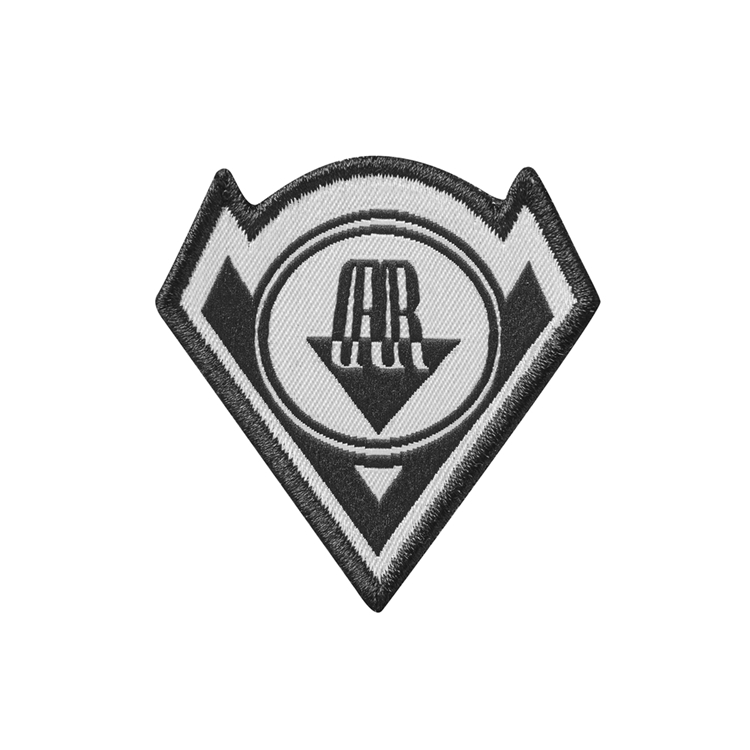
Merrowed border uses an overlock stitch that wraps completely around the raw edge of the patch, encasing the cut twill and backing layers inside a continuous thread loop. The result is a rounded, raised edge with a classic uniform appearance. Merrowed borders work best on regular geometric shapes such as circles, ovals, rectangles, shields, and simple custom shapes with smooth curves. This finish provides excellent fray resistance and is the standard choice for military, police, fire department, and formal organizational insignia.
Heat-cut edge uses a heated blade to slice through the patch material while simultaneously sealing the fabric fibers together. The resulting edge is flat, thin, and smooth, with no raised stitch border. Heat cutting supports intricate custom shapes, internal cutouts, and sharp angular details that cannot be achieved with a merrow machine. Patches with heat-cut edges sit flatter against the garment and work well for fashion applications, retail apparel, and designs where the shape itself is part of the brand identity.
Laser-cut edge employs a precision laser beam to vaporize fabric along the design outline, producing extremely sharp detail and clean edges with zero fraying. Laser technology handles the most complex custom shapes, fine interior cutouts, and delicate perforated patterns. The edge remains smooth and sealed, and the process generates consistent results across large production runs. Laser cutting is specified for highly detailed brand marks, intricate decorative patches, and designs that demand pixel-perfect shape accuracy.
Backing and Attachment Systems
Backing selection determines installation method, removability, and end-user experience. Each backing type carries different adhesion strength, flexibility, and compatibility with target fabrics.
Sew-on backing is the plain twill reverse side of the patch with no additional adhesive layer. Attachment is performed by stitching around the perimeter or through the body of the patch. Sew-on application creates the most permanent bond and withstands the highest number of wash cycles without failure. It is the required standard for most uniform programs, military specifications, and industrial workwear where patches must remain in place for the life of the garment. Sew-on backing also allows for repositioning during professional application and works with the widest range of fabric types.
Iron-on backing incorporates a heat-activated adhesive film laminated to the reverse side of the patch. When pressed with a household iron or heat press at the correct temperature and pressure, the adhesive melts and bonds to the target fabric. Iron-on patches offer convenient no-sew application for end users and work well with cotton, denim, canvas, and most woven garment fabrics. The adhesive bond is permanent once properly applied and survives regular washing when installed correctly. Thicker or heat-sensitive fabrics may require alternative attachment methods to avoid damaging the garment.
Hook and loop backing consists of two mating fabric strips, one with rigid hooks and one with soft loops. The hook side attaches to the back of the patch, while the loop side is sewn onto the garment. This system allows patches to be removed, swapped, and reattached as needed. It is the standard for tactical gear, police and military uniforms, morale patch collections, and any application where interchangeability is required. Hook and loop backing adds thickness to the patch and is available in sew-on or iron-on hook attachment variants.
Pressure-sensitive adhesive backing features a peel-off release paper covering a sticky adhesive layer. The patch adheres instantly when pressed onto a clean surface, with no heat or sewing required. Pressure-sensitive backing works best for temporary applications, event use, promotional giveaways, and placement on hard surfaces such as notebooks, helmets, and luggage. It is not recommended for permanent garment application, as adhesive may soften during washing and lose bond strength over time.
Size and Shape Customization
Patch dimensions are measured by averaging the vertical and horizontal maximum measurements of the design. Sizing directly affects detail reproduction, stitch count, and per-unit cost.
Small patches in the 2 to 3 inch range are ideal for hat fronts, collar points, shirt sleeves, bag straps, and small accessory placement. At this size, artwork must be simplified to maintain legibility, with text elements kept to a minimum and line thickness meeting minimum stitch width requirements. Bold shapes and high-contrast color combinations read best on smaller formats.
Medium patches from 3 to 4 inches cover the most common applications, including jacket chest placement, uniform sleeves, backpack panels, and standard team emblems. This size range accommodates most logo designs comfortably, supports multiple text elements, and balances visibility with proportional placement on adult-sized garments.
Large patches measuring 5 inches and up serve as back patches, jacket centerpieces, blanket emblems, and statement display pieces. Larger canvas area allows for highly detailed artwork, multiple decorative elements, extensive text, and elaborate border treatments. Biker vest back patches and club emblems commonly fall into this category, often reaching 10 to 12 inches in width for full-back coverage.
Shape options extend far beyond basic circles and rectangles. Custom die-cut shapes follow the exact outline of the artwork, creating silhouette patches that match the logo contour precisely. Shields, crests, stars, hearts, animal silhouettes, vehicle outlines, and fully custom organic shapes are all producible. Internal cutouts and negative space details are achievable with laser or heat-cut edge methods.
Technical Specification Tables
Standard Product Parameters
|
Parameter
|
Specification
|
|
Base fabric
|
Cotton twill, polyester twill, felt, custom fabric matching
|
|
Thread material
|
Standard polyester, optional rayon, metallic, neon, glow-in-the-dark
|
|
Standard color count
|
Up to 9 colors included base price, extended to 12+ on request
|
|
Color matching
|
Pantone solid coated matching available
|
|
Embroidery coverage
|
50%, 75%, 100% options
|
|
Standard sizes
|
2 inch to 6 inch diameter, custom sizing available
|
|
Edge finishes
|
Merrowed border, heat-cut, laser-cut
|
|
Backing options
|
Sew-on, iron-on, hook and loop, pressure-sensitive adhesive, magnetic
|
|
Minimum stitch density
|
70 stitches per square centimeter standard
|
|
Wash durability
|
50+ domestic wash cycles with proper application
|
|
Temperature resistance
|
-20°C to 80°C operating range
|
|
Lead time sample
|
3 to 5 business days
|
|
Lead time production
|
7 to 15 business days depending on quantity
|
Coverage Level Comparison
|
Coverage Level
|
Stitch Density
|
Best Application
|
Visual Weight
|
Relative Cost
|
|
50%
|
Moderate, exposed twill visible
|
Simple text, outline logos, economy orders
|
Light
|
Lower
|
|
75%
|
Medium-high, minimal twill visible
|
Team logos, uniform patches, general branding
|
Medium
|
Mid-range
|
|
100%
|
Maximum, full thread surface
|
Premium insignia, collector patches, full emblems
|
Heavy
|
Higher
|
Backing Type Performance
|
Backing Type
|
Installation Method
|
Removable
|
Wash Durability
|
Best Use Case
|
|
Sew-on
|
Stitch by machine or hand
|
No
|
Highest
|
Uniforms, workwear, permanent application
|
|
Iron-on
|
Heat press or household iron
|
No, once applied
|
High
|
Apparel, denim, canvas, consumer DIY
|
|
Hook and loop
|
Hook on patch, loop on garment
|
Yes, fully interchangeable
|
High
|
Tactical gear, morale patches, uniforms
|
|
Pressure-sensitive
|
Peel and stick
|
Temporary repositioning
|
Low
|
Promotional, events, hard surfaces
|
Production Quality Standards
Embroidered patches custom manufactured to commercial grade standards follow specific quality control checkpoints at every production stage.
Artwork digitization is the first and most critical quality step. Experienced digitizers convert vector artwork into stitch files, mapping out stitch direction, underlay structure, density settings, and color stops for each thread change. Proper digitization prevents thread bunching, gap formation, fabric pull, and misregistration between color layers. Each design is reviewed for minimum line thickness, minimum text height, and adjacent color separation to ensure clean reproduction in thread form.
Sample production precedes every full run. A physical first article patch is stitched and inspected against the approved artwork for color accuracy, placement, dimension, stitch quality, and edge finish. Samples allow for adjustments to stitch density, color matching, and design details before committing to full production. Photograph proofs or physical sample shipments are provided for customer approval prior to bulk manufacturing.
Production inspection occurs at multiple points during the run. Machine operators monitor thread tension, color registration, and stitch quality throughout the sewing process. Finished patches go through trimming, backing lamination, edge finishing, and final QC where each piece is checked for loose threads, skipped stitches, stain marks, dimension variance, and edge defects. Only pieces meeting all specification criteria move forward to packaging and shipment.
Application and Care Guidance
Proper installation and maintenance extend the service life of custom embroidered patches significantly.
For iron-on application, set the iron to the cotton setting with steam disabled. Place the patch in position on the garment, cover with a thin pressing cloth, and apply firm pressure for 12 to 18 seconds depending on patch size. Turn the garment inside out and press from the reverse side for an additional 10 seconds to ensure full adhesive activation. Allow the patch to cool completely before handling or wearing. Test heat compatibility on an inconspicuous area of delicate fabrics before full application.
For sew-on installation, use matching color polyester thread and a tight, even stitch around the perimeter. A straight stitch 1 to 2 millimeters inward from the edge provides the cleanest appearance. For high-stress applications, a double row of stitching or bar tacks at stress points reinforces attachment. Professional sewing equipment produces the most uniform and durable results.
Washing and care follow standard garment instructions. Turn garments inside out before laundering to protect the embroidered surface from abrasion. Use mild detergent and avoid bleach or harsh chemical treatments that can degrade thread color and backing adhesive. Air drying or low-heat tumble drying preserves patch appearance longer than high-heat drying cycles. Do not dry clean patches with iron-on backing, as dry cleaning solvents can dissolve the adhesive layer.
Ordering Custom Embroidered Patches
The ordering process begins with artwork submission. Vector files in AI, EPS, or PDF format with outlined text produce the most accurate results. High-resolution raster files at 300 DPI or higher can also be used, though additional redrawing time may apply. Artwork is reviewed for embroidery feasibility, and any necessary adjustments are communicated before production begins.
Quantity tiers follow standard industry breakpoints, with unit pricing decreasing as order volume increases. Typical quantity breaks occur at 50, 100, 200, 500, 1000, and 5000 pieces. Small minimum order quantities accommodate startup brands, small teams, and test runs, while high-volume production capacity supports national retail programs and large uniform rollouts.
Production timelines vary based on order size, complexity, and current factory schedule. Standard production runs complete within 7 to 15 business days after sample approval. Rush production options are available for time-sensitive orders with expedited processing and shipping. All shipments include quality documentation and are packaged to prevent bending, creasing, and moisture damage during transit.
Custom embroidered patches remain a staple branding solution for their combination of durability, perceived value, and tactile aesthetic that no print process can replicate. From single-color text emblems to full-color multi-element crests, the medium supports virtually any brand identity with precision stitching and consistent repeatable quality across production runs of every size.
Subtle Debossed Labels Make Strong Brand Statements
Champion Patches Bring Heritage Style to Apparel Logos




SEND MESSAGE