
Differences Between Various Types of 3D Puff Patches
2026-01-22
Table of Contents
3D puff patches, as a popular decorative and functional accessory in the garment and accessory industry, are favored for their distinctive three-dimensional stereoscopic effect.
Unlike flat patches, they add a sense of hierarchy and tactile appeal to products, making them widely used in casual wear, sportswear, workwear, and even promotional items.
The core value of 3D puff patches lies in balancing aesthetic decoration and practicality—they not only highlight brand logos or design elements but also enhance the durability of local garment areas. This article aims to clarify the differences between various types of 3D puff patches by classifying them from multiple dimensions, providing a clear reference for product selection in different scenarios.
Classification Criteria of 3D Puff Patches
The classification of 3D puff patches is not unified, and it can be divided according to different core criteria. Each classification dimension reflects the unique characteristics of the patches, helping to distinguish their applicability in production and application.
Classifying by core material focuses on the raw material that determines the patch’s texture and performance. Classifying by manufacturing process emphasizes the production method that affects the patch’s shape accuracy and batch consistency.
Classifying by 3D stereoscopic height is based on the visual and tactile sense brought by the patch’s thickness. Classifying by application and fixation method is closely related to the patch’s practical use and installation convenience. These criteria complement each other, forming a comprehensive classification system.
Detailed Comparison of 3D Puff Patch Types
Classification by Core Material
Silicone 3D puff patches are characterized by soft texture and high elasticity, with excellent waterproof performance. They are skin-friendly and do not cause irritation even when in direct contact with the skin for a long time, making them suitable for children’s clothing and intimate wear.
Their advantages include strong durability and resistance to high and low temperatures, which can maintain their shape and performance after multiple washes. However, compared with PVC alternatives, silicone patches have a higher production cost, which limits their large-scale application in low-budget products. A key distinguishing point is their matte surface, which is very different from the glossy texture of PVC patches.
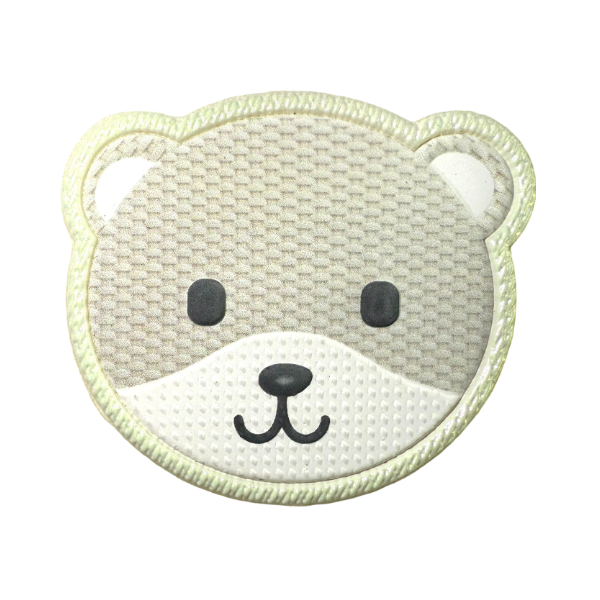
PVC 3D puff patches have a relatively rigid texture and can present clear pattern details. They are favored by manufacturers for their low cost and can be customized into various bright colors to meet personalized design needs.
Nevertheless, their flexibility is poor, and they are prone to hardening or deformation when exposed to extreme heat, making them unsuitable for tight-fitting clothing that requires frequent stretching. In terms of touch, PVC patches are harder than silicone ones, which is a direct way to distinguish the two.
Fabric-backed 3D puff patches adopt a hybrid structure, combining a fabric base with a silicone or PVC 3D puff layer. This design allows the patch to have better adhesion to the garment fabric, achieving a seamless fit effect and avoiding the sense of abruptness caused by single-material patches.
The disadvantage is that the production process is more complex, involving both fabric cutting and 3D layer molding, which increases the production cycle and cost. Compared with single-material patches, their hybrid structure is the most obvious distinguishing feature.
Classification by Manufacturing Process
Injection-molded 3D puff patches are produced by injecting raw materials into molds, resulting in uniform thickness and precise 3D shapes. This process ensures high consistency in batch production, making each patch’s size and shape highly consistent, which is suitable for designs with intricate patterns and strict size requirements.
The main disadvantage is that it requires custom molds, which increases the initial investment cost, making it less economical for small-batch production. Their smooth surface and accurate size control are important characteristics that distinguish them from other process types.
Embossed 3D puff patches form a 3D effect through pressing and heating processes, without the need for custom molds. This reduces the initial cost, making them cost-effective for small-batch or customized orders.
However, the stereoscopic height of embossed patches is limited, usually lower than that of injection-molded ones, and the 3D relief effect is relatively subtle. The lower 3D sense is the core difference between embossed patches and injection-molded patches.

Heat-transfer 3D puff patches have a thin 3D layer and can be transferred to the garment surface through a heat press. They are easy to apply, do not require sewing, and are suitable for rapid production and small-batch processing.
The disadvantage is that their durability is lower than that of sewn patches, and they may peel off after multiple washes or frequent friction. They are lightweight and suitable for delicate fabrics such as silk and cotton, which are important distinguishing points from other process types.
Classification by 3D Stereoscopic Height
| Classification Type | Thickness Range | Applicable Scenarios | Core Features |
|---|---|---|---|
| Low-profile 3D Puff Patches | ≤2mm | Formal wear, lightweight apparel, and accessories requiring a neat appearance | Subtle 3D effect; non-bulky design that does not affect garment fit and comfort; low-key decoration while maintaining garment simplicity |
| Medium-profile 3D Puff Patches | 2–5mm | Casual wear, brand logos, and daily accessories | Balances stereoscopic effect and wearing comfort; effectively highlights design elements without discomfort from excessive thickness; most widely used type |
| High-profile 3D Puff Patches | >5mm | Sportswear, outdoor gear, and decorative badges | Bold visual impact and obvious tactile feel; prominent bulging effect; showcases a strong design style and attracts attention |
Application Scenario Matching by Patch Type
Silicone 3D puff patches are suitable for sportswear, children’s clothing, and swimwear. Their waterproof and skin-friendly properties can adapt to the sweating of sportswear and the safety needs of children’s clothing, while also resisting the erosion of water in swimwear.
PVC 3D puff patches are widely used in workwear, outdoor equipment, and brand emblems. Their low cost and clear pattern expression can meet the large-scale needs of workwear, and their rigidity can adapt to the wear and tear of outdoor equipment.
Heat-transfer 3D puff patches are suitable for T-shirts, lightweight blouses, and small accessories. Their easy application method is suitable for the rapid production of T-shirts and blouses, and they will not damage the delicate fabric structure.
High-profile 3D puff patches are mostly used in streetwear, team uniforms, and promotional items. Their bold 3D effect can highlight the personality of streetwear and the team characteristics of uniforms, and can quickly attract attention in promotional items.
Key Factors for Choosing the Right Type
Cost budget is an important factor in selecting 3D puff patches. PVC patches are the first choice for low-budget projects, while silicone patches are suitable for medium and high-end products with higher quality requirements. Fabric-backed patches are recommended only when seamless fit is required, considering the higher cost.
Garment material compatibility needs to be considered. Delicate fabrics such as silk and cotton are suitable for lightweight heat-transfer patches, while heavy fabrics such as denim and canvas can use injection-molded or PVC patches with higher rigidity.
Design requirements determine the process and height of the patch. Intricate patterns require injection-molded patches to ensure accuracy, while bold 3D effects need high-profile patches. For simple patterns and small batches, embossed patches are more economical.
Usage environment affects the material selection. Outdoor or water-exposed products should choose waterproof silicone or PVC patches, while indoor clothing can use fabric-backed or heat-transfer patches with lower durability requirements.
Conclusion
Various types of 3D puff patches have obvious differences in material, process, height, and application scenarios. Silicone and PVC patches differ in texture and cost; injection-molded and embossed patches vary in accuracy and batch adaptability; low-profile and high-profile patches are distinguished by visual and tactile effects.
When selecting 3D puff patches, it is necessary to comprehensively consider cost budget, garment material, design requirements, and usage environment to choose the most suitable type. By grasping these core differences, we can give full play to the decorative and functional value of 3D puff patches and improve the quality and competitiveness of products.
PEPHAWK is proud to highlight our integrated one-stop service—seamlessly combining professional design, R&D, and manufacturing capabilities to deliver cohesive, end-to-end solutions for our valued clients.
Our core product range covers a diverse selection of high-quality accessories and silicone-based items, including:
- Garment Accessories: Silicone Labels, Micro Fiber Labels, TPU Labels, Leather Labels
- Electronic & Lifestyle Gadgets: Silicone Mobile Phone Skins, Silicone MP3 Skins, Silicone Chaplets, Silicone Bracelets
Beyond our core offerings, we also connect clients with complementary products through our trusted affiliated companies, ensuring all your needs are met under one partnership.
What sets us apart is our specialized expertise in key manufacturing processes: Silk Screen Printing, High-Frequency Welding, Sublimation Printing, Seamless Fabric Processing, and Laser Cutting. These capabilities allow us to serve a wide array of industries—from garments, shoes, caps, and gloves to electronic devices, bags, and sporting equipment—with products that blend durability, functionality, and aesthetic appeal.
At PEPHAWK, customer satisfaction is our top priority. We’re committed to providing responsive, thorough support, and guarantee a same-day response to all inquiries—no exceptions. You can rely on us for consistent quality, reliable delivery, and a partnership that’s as efficient as it is trustworthy.
Whether you’re looking for custom apparel labels, protective silicone skins, or tailored manufacturing solutions, PEPHAWK has the expertise and flexibility to bring your vision to life.
How to Put Patches on a Jacket: Common Mistakes and Corrections
How to Choose PVC Rubber Patch in 2026


SEND MESSAGE